
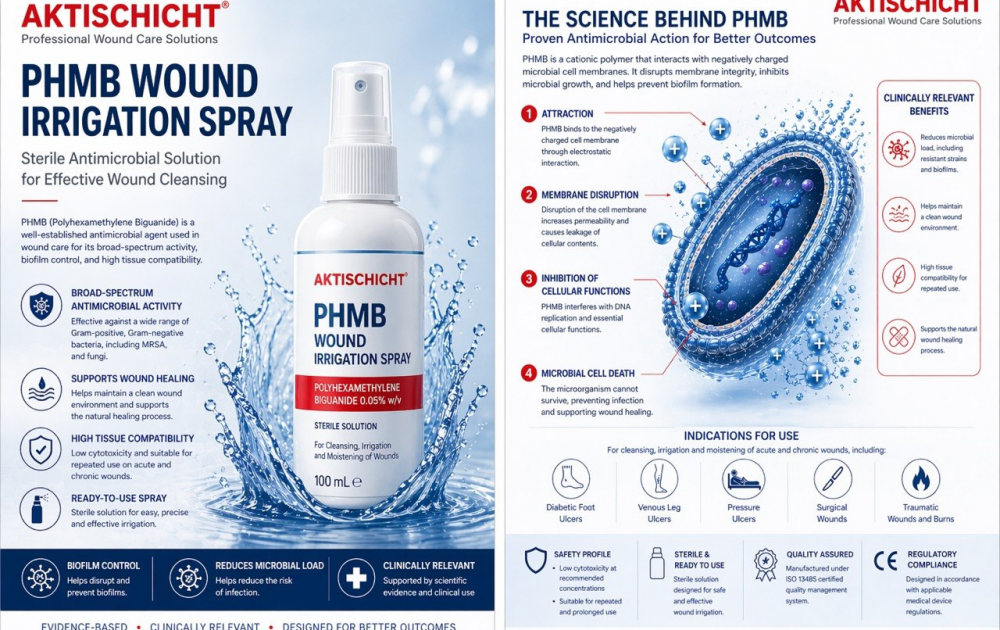
Mechanism of Action
Antimicrobial Activity (Primary Mode of Action)
PHMB is a cationic polymer that interacts selectively with negatively charged microbial cell membranes.
Mechanism:
• Disruption of bacterial cell membrane integrity
• Increased permeability → leakage of intracellular components
• Binding to microbial DNA → inhibition of replication
• Result: rapid microbial cell death
PHMB demonstrates broad-spectrum antimicrobial activity, including:
• Gram-positive bacteria
• Gram-negative bacteria
• Fungi
It has also shown activity against biofilm-associated microorganisms, which are commonly implicated in chronic wounds.
Clinical relevance: Biofilms are reported in a majority of chronic wounds and contribute to delayed healing.
Effects on Wound Healing Environment
PHMB supports wound healing indirectly through:
• Reduction of microbial burden
• Maintenance of a clean wound environment
• High tissue compatibility (low cytotoxicity at clinical concentrations)
These factors contribute to:
• Improved conditions for granulation and epithelialization
• Reduced risk of infection-related complications
Inflammation and Pain
PHMB is still not classified as an anti-inflammatory or analgesic agent. However, clinical evidence indicates that:
• Reduction of microbial load may decrease local inflammatory responses
• Patients may experience reduced wound-associated pain as a secondary outcome of infection control and improved wound conditions
These effects should be considered indirect and supportive, not primary pharmacological actions.
References
Core PHMB Mechanism & Safety
• Kaehn K.
Polyhexanide: a safe and highly effective biocide.
Skin Pharmacol Physiol. 2010.
https://pubmed.ncbi.nlm.nih.gov/20389192/
• Müller G, Kramer A.
Biocompatibility index of antiseptic agents by parallel assessment of antimicrobial activity and cellular cytotoxicity.
J Antimicrob Chemother. 2008.
https://pubmed.ncbi.nlm.nih.gov/18222935/
• Hübner NO, Kramer A.
Review on the efficacy, safety and clinical applications of polihexanide (PHMB).
Skin Pharmacol Physiol.
https://pubmed.ncbi.nlm.nih.gov/20484969/
Biofilm and Antimicrobial Efficacy
• Kaehn K, Eberlein T.
Polyhexanide in wound treatment – mechanisms and clinical applications.
[https://pmc.ncbi.nlm.nih.gov/articles/PMC9143489/](https://pmc.ncbi.nlm.nih.gov/articles/PMC9143489/)
• Lenselink EA, Andriessen A.
A cohort study on the efficacy of a PHMB-containing wound care product.
[https://pubmed.ncbi.nlm.nih.gov/21242737/](https://pubmed.ncbi.nlm.nih.gov/21242737/)
• Hill KE et al.
An in vitro model of chronic wound biofilms to test antimicrobial effectiveness.
[https://pubmed.ncbi.nlm.nih.gov/28266133/](https://pubmed.ncbi.nlm.nih.gov/28266133/)
• Günther F et al.
Antimicrobial efficacy of antiseptics on biofilms.
[https://pubmed.ncbi.nlm.nih.gov/33162949/](https://pubmed.ncbi.nlm.nih.gov/33162949/)
Clinical Outcomes (Pain / Healing Support)
• Norman G et al.
Antiseptics for burns and wounds: Cochrane review.
[https://pubmed.ncbi.nlm.nih.gov/27608742/](https://pubmed.ncbi.nlm.nih.gov/27608742/)
• Andriessen AE et al.
Randomized controlled trial evaluating PHMB wound care products.
[https://pubmed.ncbi.nlm.nih.gov/21242737/](https://pubmed.ncbi.nlm.nih.gov/21242737/)
Comparative and Safety Context
• Kramer A et al.
Antiseptic agents in modern wound care.
https://pmc.ncbi.nlm.nih.gov/articles/PMC8953877/
Biofilm and Chronic Wounds (Contextual Science)
• Wolcott RD, Rhoads DD.
Biofilms and chronic wound inflammation.
[https://pubmed.ncbi.nlm.nih.gov/24527369/](https://pubmed.ncbi.nlm.nih.gov/24527369/)
• Percival SL et al.
Biofilms and wounds: an overview.
[https://pubmed.ncbi.nlm.nih.gov/23390373/](https://pubmed.ncbi.nlm.nih.gov/23390373/)
Safety and Biocompatibility
• PHMB exhibits low cytotoxicity toward human keratinocytes and fibroblasts at clinically used concentrations
• Suitable for repeated application and prolonged use
• Generally well tolerated in wound care applications
Solution
• Saline (0.9% NaCl)
• Hypochlorous acid (HOCl)
• Povidone-iodine (PVP-I)
• Alcohol (ethanol / isopropanol)
• Octenidine (OCT)
• PHMB
Primary Function
• Mechanical wound cleansing
• Antimicrobial wound cleansing
• Broad-spectrum antiseptic
• Skin disinfection (intact skin)
• Antiseptic (skin, mucosa, wounds)
• Antimicrobial wound cleansing and irrigation
Advantages
• Non-irritating, widely used
• Broad antimicrobial activity, generally well tolerated
• Effective against bacteria, fungi, viruses
• Rapid antimicrobial action
• Broad-spectrum antimicrobial activity; good tolerability in approved indications
• Broad-spectrum antimicrobial activity; documented use in wound care; favorable biocompatibility profile at appropriate concentrations
Limitations/Considerations
• No intrinsic antimicrobial activity
• Limited persistence of antimicrobial effect; activity may be reduced in presence of organic matter
• Demonstrates cytotoxicity in vitro; clinical use requires appropriate concentration and exposure control
• Not indicated for open wounds due to cytotoxicity, pain, and potential tissue damage
• Clinical evidence in chronic wound management exists but is more limited compared to some established wound care agents; use should follow approved indications
• Requires controlled formulation and concentration; efficacy depends on proper clinical use